DeepSeek announced V4.1 Flash on 10 September 2026, introducing native image understanding and a new model architecture designed to make long agent sessions cheaper to serve. It is available through the DeepSeek API as deepseek-flash. The official announcement also contains an immediate operational change: existing V4-Flash and experimental vision requests already route to the new model, and V4-Pro requests are scheduled to follow on 14 September.
This coverage was checked against first-party sources on 11 September 2026. It explains the release and its practical implications; AIEngine has not independently reproduced DeepSeek’s benchmark results. For the mechanisms behind the efficiency claims, read our companion technical analysis of CED, CSA2 and bounded replay.
What has been released?
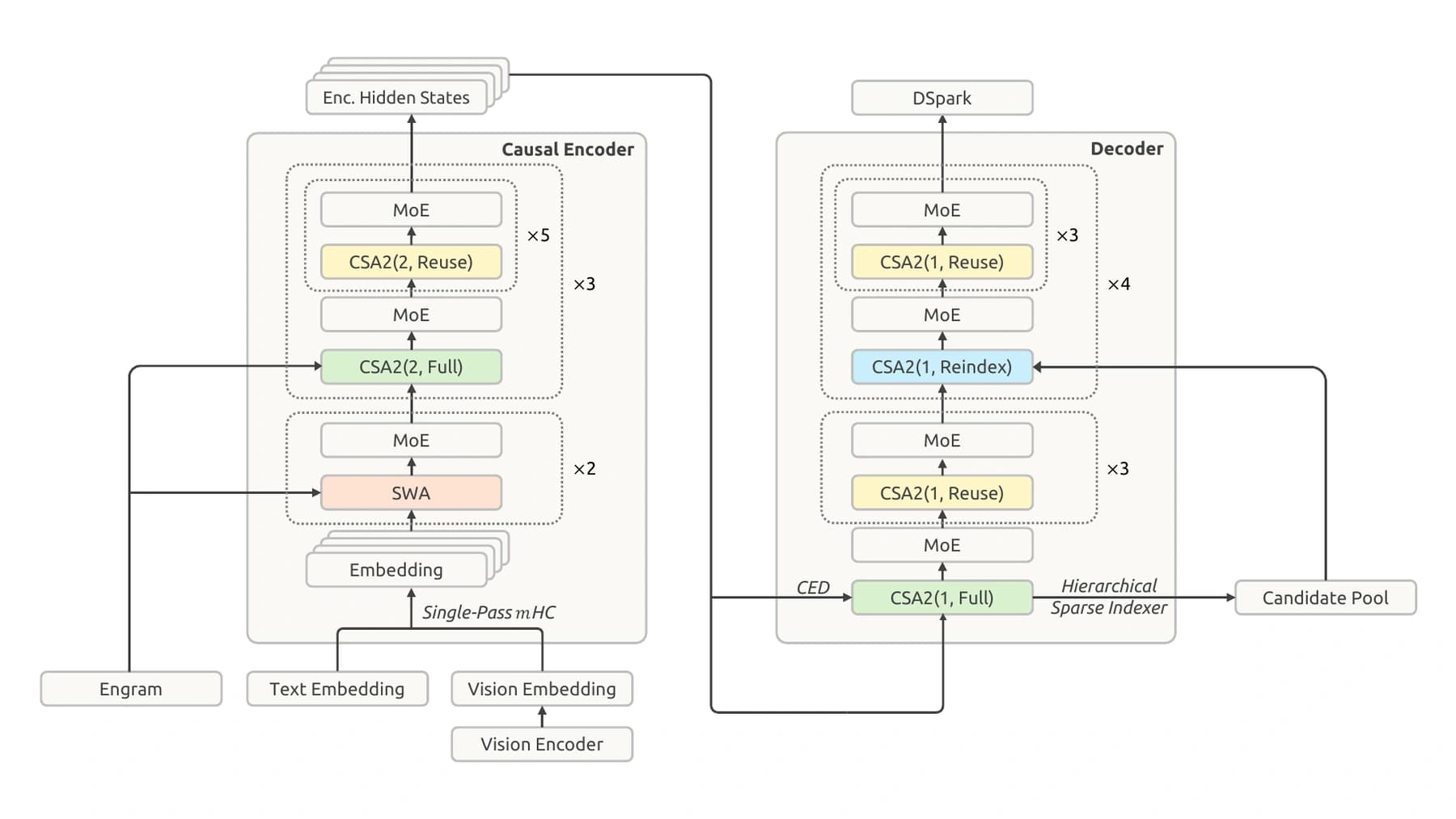
The model card describes a multimodal mixture-of-experts model that accepts text and images and generates text. This is a new architecture and pretraining run, rather than another post-training update to the July V4-Flash checkpoint.
| Detail | V4.1 Flash |
|---|---|
| Direct DeepSeek API name | deepseek-flash |
| Context window | 1 million tokens |
| Maximum API output | 384,000 tokens |
| Input and output | Text and images in; text out |
| Language backbone | 552 billion parameters |
| Activated backbone parameters | About 8B during prefill; 16B during decode |
| Released weights | Available from DeepSeek’s Hugging Face repository |
The context and output limits come from the current API specification and pricing page. They are ceilings, not suggested defaults. Applications still need bounded output, timeouts and task-specific context selection.
The 552B figure is the language backbone. The technical report separately describes 196B parameters of Engram conditional memory. Neither the backbone count nor the active count is a complete estimate of the hardware needed to host the released model.
Native vision changes the agent workflow
The vision guide documents images in the same request as text, with JPEG, PNG, GIF and WebP support. Images can arrive through inline data, a public URL or a Files API reference. The supported interfaces include Chat Completions and Responses, although their image-content fields differ.
For a coding assistant, this creates a direct route from rendered interface to visual inspection. For a document workflow, it makes charts, scanned tables and screenshots available to the same model that reasons about the surrounding text. Those are useful evaluation scenarios, rather than a guarantee of accurate extraction.
Consider an invoice screenshot with a unit in the column heading and a total in a footnote. A successful response must preserve their relationship, identify uncertainty and avoid inventing an unreadable value. Our guide to extracting numbers with units and precision gives a concrete acceptance contract for that kind of test.
Native visual understanding also differs from image generation. The released model produces text; a product that creates images through a separate tool is offering an additional capability. Check whether the integration actually sends the image, its resolution and the relevant surrounding context before attributing a result to the model.
Why DeepSeek says it is cheaper
The technical report, sections 2 and 3, describes three complementary changes. A causal encoder–decoder reduces the computation needed to process most prompt tokens. Cross-layer attention reuse and lower-precision cache storage reduce the global KV cache, the stored attention state used to revisit earlier context. Bounded replay reconstructs local attention state instead of keeping it in long-term cache storage.
DeepSeek reports roughly one-quarter of V4-Flash’s global KV footprint and one-eighth of its persistent KV footprint. These are specific memory comparisons. They do not mean an entire GPU deployment uses one-quarter of the memory, or every application becomes eight times faster.
Our interpretation is that the strongest fit is an input-heavy agent: many tool results, repeated context and relatively short additions per turn. Savings in prompt processing and cache movement matter there. A short, uncached request dominated by output generation exercises a different cost profile, so it needs a separate measurement.
Benchmarks show gains and remaining gaps
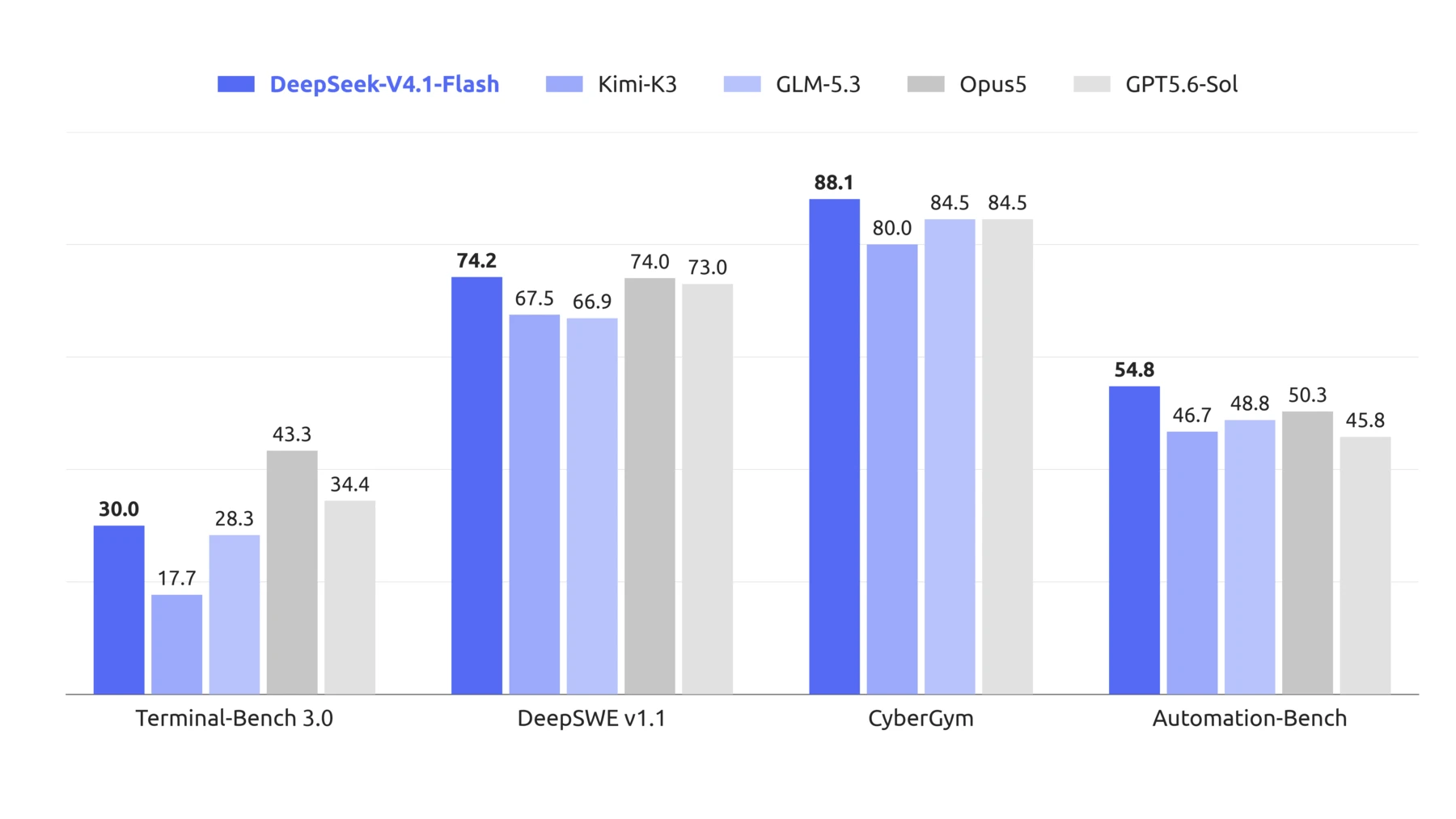
Selected results from Table 3 of DeepSeek’s technical report are shown below. Values are percentages: pass@1 for the terminal and automation tasks, and resolved rate for DeepSWE.
| Evaluation | V4-Flash | V4-Pro | V4.1 Flash |
|---|---|---|---|
| Terminal-Bench 2.1 | 82.7 | 87.9 | 90.6 |
| Terminal-Bench 4.0 | 7.0 | 12.4 | 31.2 |
| DeepSWE v1.1 | 54.4 | 62.7 | 74.2 |
| AutomationBench | 37.7 | 43.2 | 54.8 |
The report’s evaluation setup and tables use maximum reasoning effort. Code-agent evaluations generally use DeepSeek Harness Minimal with a 1M-token context, temperature 1.0 and top-p 0.95; DeepSWE uses mini-SWE. AutomationBench uses its official scaffold. A model embedded in a different agent may produce different results.
The official chart above also shows where V4.1 Flash trails: Terminal-Bench 3.0 is 30.0, below Opus 5 at 43.3 and GPT-5.6 Sol at 34.4. On the harder Terminal-Bench 4.0, the report lists 31.2 against 51.8 and 39.9 respectively. Broad claims that it beats every flagship on every task would misrepresent the evidence.
Even a narrow lead needs interpretation. The reported DeepSWE score of 74.2 versus Opus 5’s 74.0 does not by itself establish a statistically significant advantage. Sample variation, effort, tools and harness behaviour belong beside the headline number. The report itself acknowledges remaining gaps on difficult expert tasks and incompletely characterised failure cases.
API pricing, with the cache categories kept separate
DeepSeek’s published direct API prices on 11 September are in US dollars per million tokens:
| Token category | Peak | Off-peak |
|---|---|---|
| Input, cache hit | $0.006 | $0.003 |
| Input, cache miss | $0.30 | $0.15 |
| Output | $1.20 | $0.60 |
Peak periods are 01:00–04:00 and 06:00–10:00 UTC, Monday to Friday; all other hours are off-peak. These prices took effect at 04:00 UTC on 10 September. Intermediary providers may have different rates and billing rules.
As an illustrative calculation, a request with 100,000 uncached input tokens and 10,000 billable output tokens costs $0.042 at peak: $0.030 plus $0.012. Off-peak, the same token counts cost $0.021. This is calculated token cost, not a measured agent-job total.
If 90,000 of those input tokens are cache hits and 10,000 are misses, the peak calculation becomes $0.00054 + $0.003 + $0.012 = $0.01554. That example shows why cache accounting matters. It assumes the stated hits occurred; a repeated-looking prompt is not proof of a billed cache hit. Sum all requests, reasoning output, retries and external tool costs when evaluating a complete task.
The migration dates developers need to record
The launch notice gives the following direct-API routing changes:
- Now: use
deepseek-flashfor V4.1 Flash. - Already retired: V4-Flash and V4-Flash-Vision-Exp; their old API names temporarily route to V4.1 Flash.
- 14 September 2026, 04:00 UTC: requests to
deepseek-v4-proare scheduled to route to V4.1 Flash and use Flash prices until V4.1 Pro launches.
An unchanged model string therefore does not guarantee unchanged behaviour. Before that deadline, rerun a representative evaluation, record the serving date and provider, and check output structure, tool calls, image handling and latency. Preserve a separately tested fallback rather than assuming the old Pro alias will restore the old model after the switch.
The thinking-mode documentation also matters for compatibility. Thinking is enabled by default at high effort. The API exposes low, high and max presets; the research model’s 1–100 effort scale should not be copied blindly into an API request. In thinking mode, temperature and presence/frequency penalties are ignored, while top-p has a 0.95 floor.
For Chat Completions requests carrying tools, preserve the prior assistant reasoning_content as the documentation requires. An adapter that discards it can break later requests even when a one-turn smoke test succeeds. Test the whole tool loop, including the result returned to the model.
Open weights, with real deployment requirements
DeepSeek publishes the weights under the repository’s MIT licence. Its minimal inference guide provides readable implementation code and weight-conversion instructions. It explicitly describes a reference implementation, with ordinary autoregressive generation, rather than the complete production serving engine discussed in the paper.
The prompt-encoding documentation and deepseek-recipe toolkit are part of that integration work. The toolkit handles protocol conversion and model prompt formats; model execution, tool execution and HTTP transport remain the application’s responsibility.
Before adopting the model, evaluate completed-task quality, total resources consumed and recovery when something fails. A useful first evaluation includes:
- A long cached session: measure reuse, completed work and total tokens across turns.
- An uncached document: measure prompt-processing time and answer correctness.
- A difficult screenshot: check small labels, units and unreadable content.
- An interrupted tool call: verify recovery without repeating a completed side effect.
- An ambiguous instruction: check whether the agent resolves uncertainty before acting.
Keep external permissions enforced by the application, and require evidence that a claimed action actually completed.
V4.1 Flash is a substantial release because it brings a different approach to the economics of sustained agent work alongside native vision. The first practical step is to establish a measured baseline before the API routing changes. The deeper engineering question—how those memory savings are obtained, and what they trade away—is the subject of our architecture deep dive.