On 22 September 2026, Anthropic released Claude Opus 5.5, the first model in its Claude 5.5 family. Anthropic says it performs at the level of Claude Fable 5.1 on most work and costs about 40% less to run than Opus 5 on typical workloads. Claude Sonnet 5.5 and Claude Haiku 5.5 are due in the coming weeks.
This release brief was checked against Anthropic's launch page, platform documentation and the 230-page system card on 22 September 2026. The headline is price-performance, but the operational detail matters as much: the default effort has changed, four request patterns now fail, and safeguard interventions can hand work to a different model. Our companion Claude Opus 5.5 system card analysis covers the risk determinations, cyber results, alignment findings and full capability tables.
Release record
| Field | Verified detail |
|---|---|
| Announcement and availability | 22 September 2026 |
| Release type | Proprietary frontier model; first of the Claude 5.5 family |
| Access | Claude products, Claude API, Amazon Bedrock, Claude Platform on AWS, Google Cloud and Microsoft Foundry |
| API identifier | claude-opus-5-5 (anthropic.claude-opus-5-5 on Bedrock) |
| Input and output | Text and images to text; 1M-token context and 128K maximum output |
| Knowledge cutoff | June 2026 |
| API price | $4 per million input tokens and $20 per million output tokens, 20% below Opus 5 |
| Cache and batch pricing | $0.20 cache reads; $5 five-minute and $8 one-hour cache writes; batch at $2 and $10 |
| Earliest retirement | Not before 22 September 2027 on Anthropic-operated platforms |
What changed
Anthropic positions Opus 5.5 for long-running agentic coding and knowledge work. Its models overview now tells developers to start with Opus 5.5 for most workloads and to reserve Fable 5.1 for demanding reasoning, or for cases where Opus 5.5 still falls short at higher effort.
The cost claim has two parts. Token prices fall by 20%, and cache reads, which Anthropic says make up most agentic and coding spend, fall by 60% from $0.50 to $0.20 per million. Anthropic also reports fewer tokens per task, which it nets to a 40% saving at default settings, and output more than 30% faster than Opus 5. A research-preview fast mode offers up to 2.5x speed at $8 and $40 per million tokens, but the documentation limits it to the Claude API; it is not offered on Bedrock, Google Cloud or Foundry.
Writing is the other stated improvement. Anthropic says Opus 5.5 puts the important information first, uses less jargon and follows supplied writing rules more closely, answering common feedback on Opus 5. Subscription plans also receive higher five-hour usage limits on Pro, Max and Team, plus a rate-limit reset that users can save for later.
Benchmarks worth retaining
Anthropic's launch table compares Opus 5.5 with Fable 5.1, Opus 5, GPT-6 Astra and GPT-5.6 Sol. The shaded cells mark the leader in each row; two of them belong to Astra.
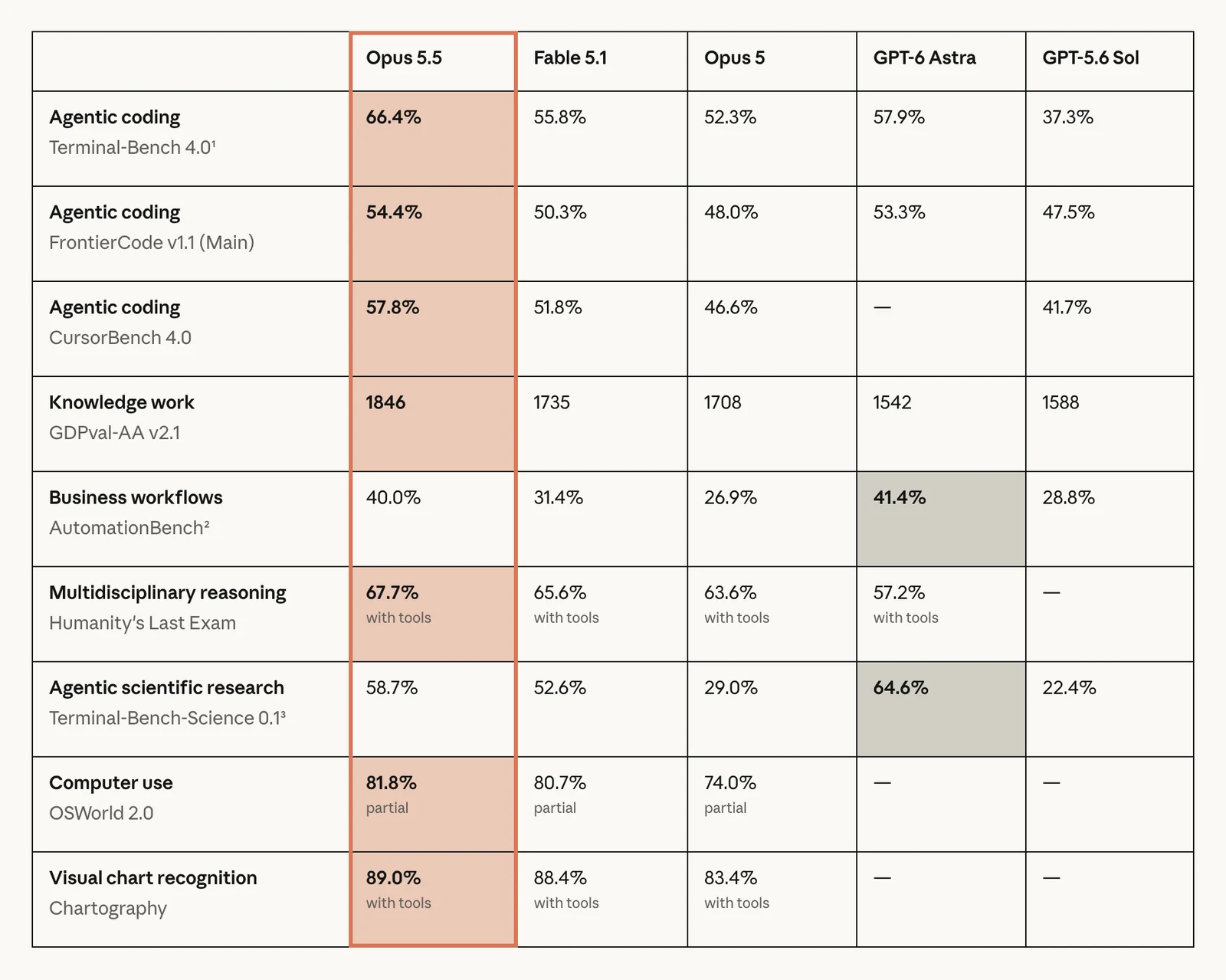
The same figures, with the conditions that change how they should be read:
| Evaluation | Opus 5.5 reported result | Comparison and reading |
|---|---|---|
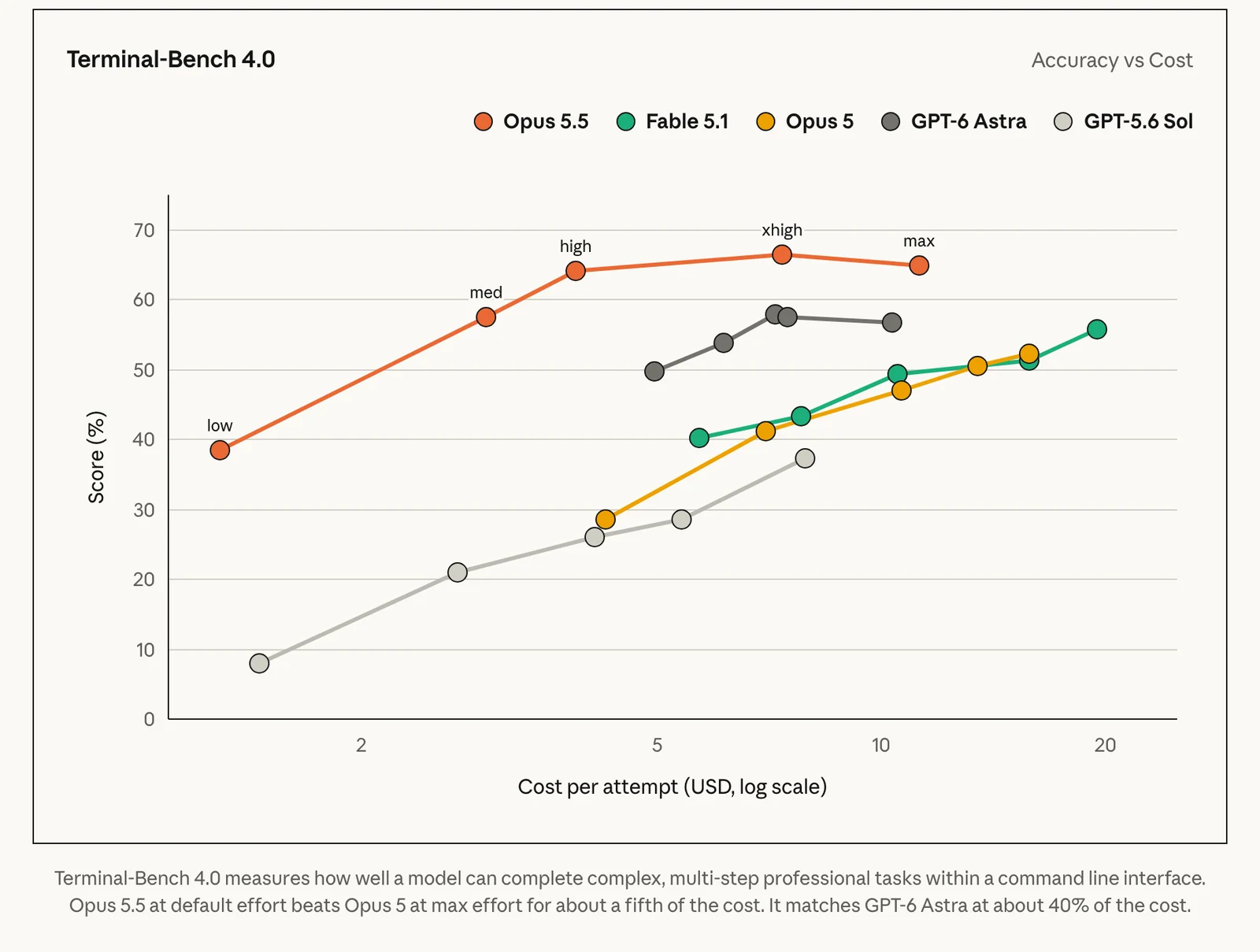
| Terminal-Bench 4.0 | 66.4% at xhigh effort | 55.8% Fable 5.1, 52.3% Opus 5; GPT-6 Astra 57.9% at high effort as reported by OpenAI; ±2.6 points standard error |
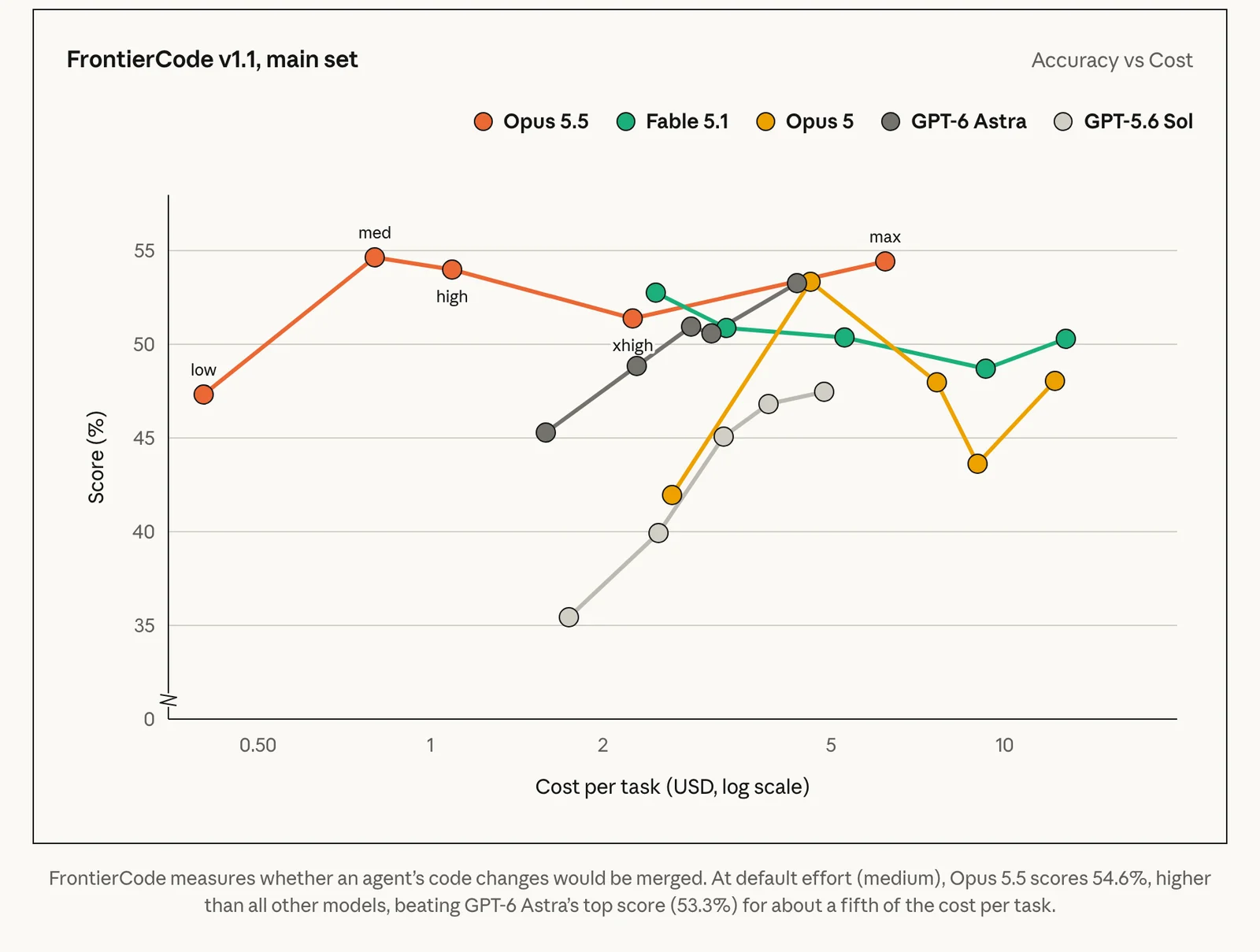
| FrontierCode v1.1 (Main) | 54.4% | 53.3% GPT-6 Astra, 50.3% Fable 5.1; 54.6% at the default medium effort |
| CursorBench 4.0 | 57.8% | 51.8% Fable 5.1, 46.6% Opus 5; 52.5% at medium effort |
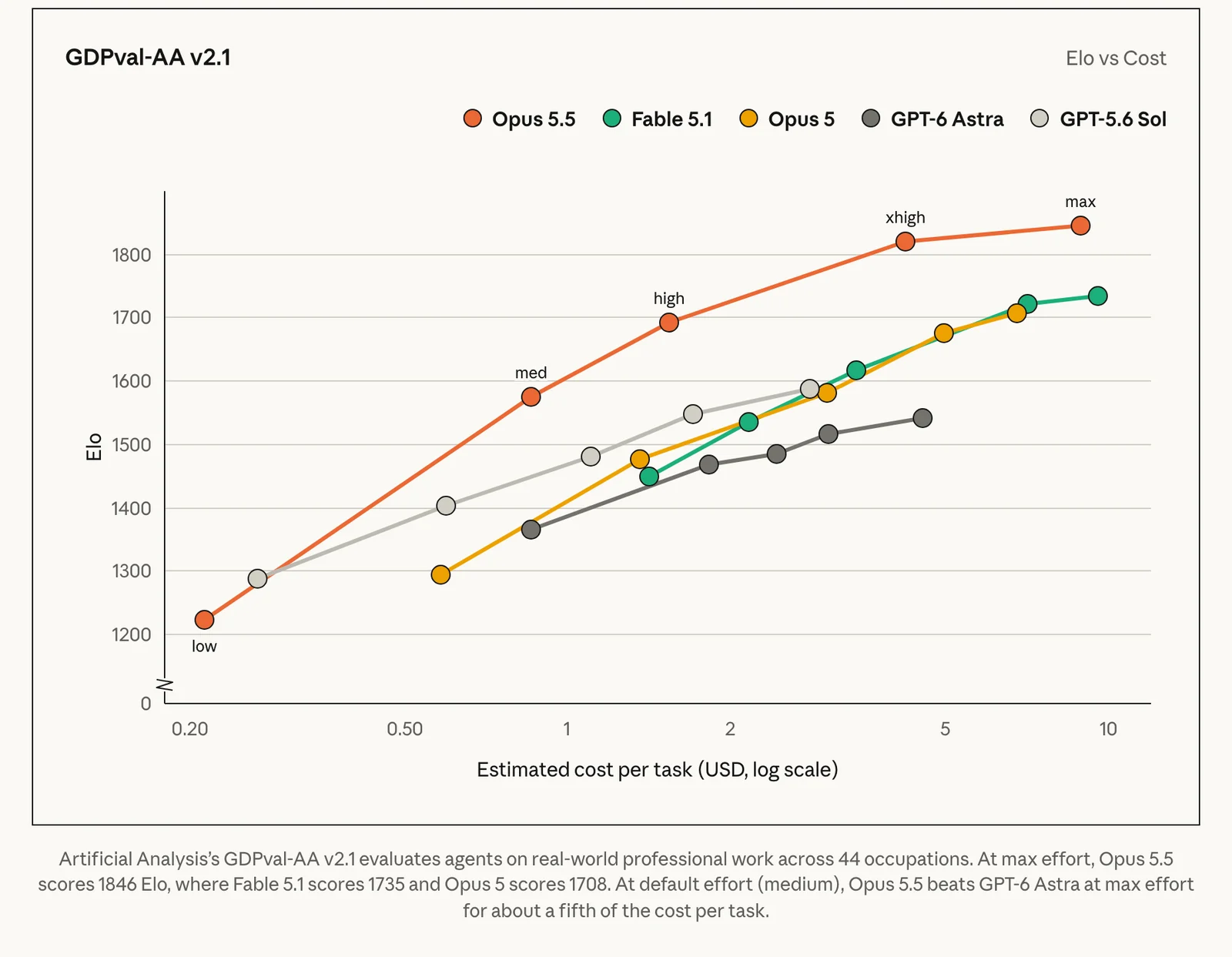
| GDPval-AA v2.1 | 1,846 Elo | 1,735 Fable 5.1, 1,708 Opus 5 and 1,542 GPT-6 Astra |
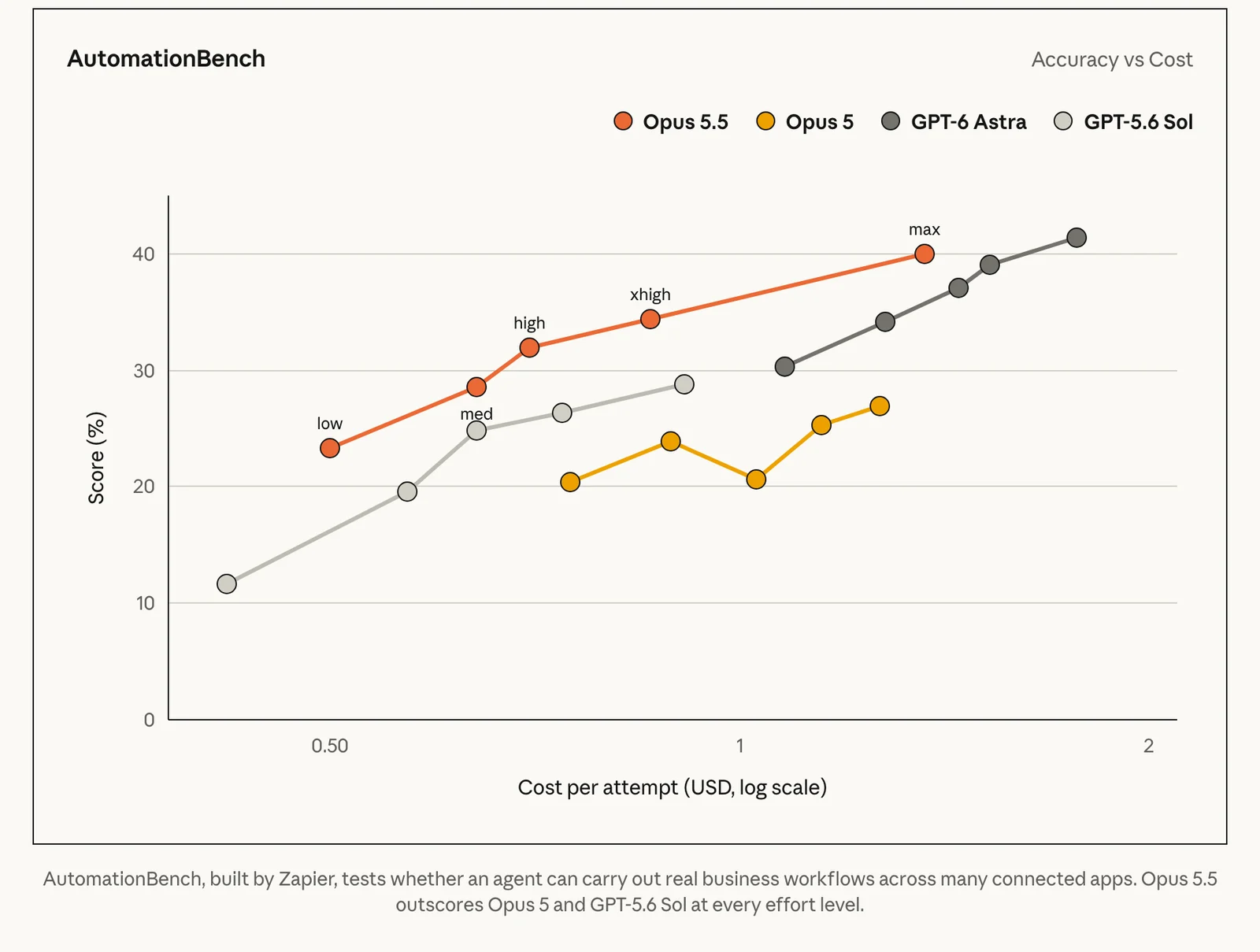
| AutomationBench | 40.0% | GPT-6 Astra leads at 41.4%; Zapier ran it without fallback, so safeguard interventions counted as failures |
| Terminal-Bench-Science 0.1 | 58.7% | GPT-6 Astra leads at 64.6%; ±3.5–5 points standard error |
| OSWorld 2.0 | 81.8% (partial) | 80.7% Fable 5.1 and 74.0% Opus 5 |
Opus 5.5 does not lead every row, and Anthropic itself says benchmark margins "have become a less reliable guide to real-world differences" at this level, with the gap to Fable 5.1 narrower in its own use than the scores suggest. Unless noted, results use adaptive thinking at max effort with production safeguards enabled. When safeguards intervened, cybersecurity tasks were completed by Claude Opus 4.8, and biology and frontier-LLM-development tasks by Opus 5.
Cost curves from the launch
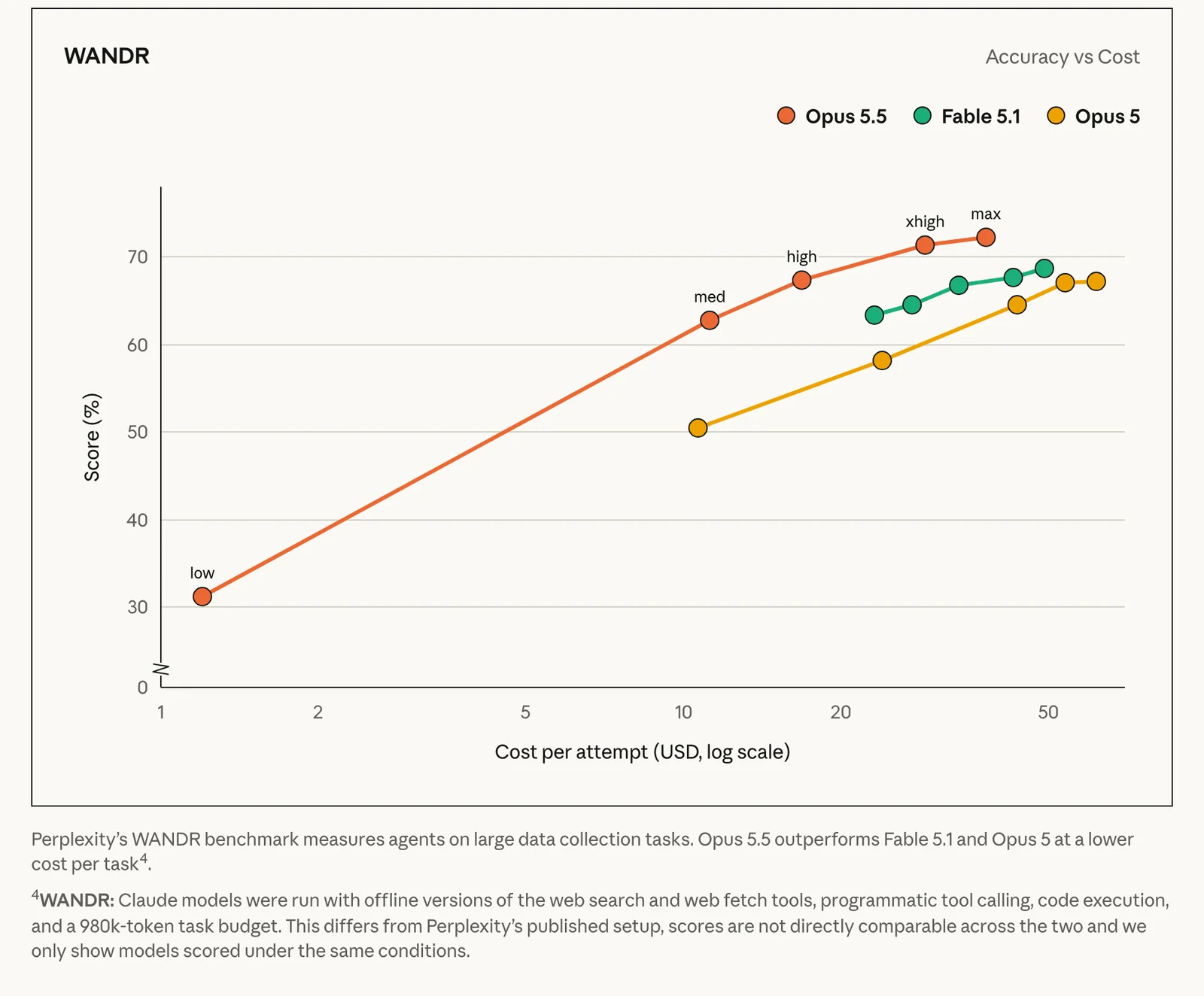
The more durable evidence is the cost curves, which plot each effort level against cost per task. Anthropic reports that Opus 5.5 at default effort beats GPT-6 Astra's top FrontierCode score at roughly a fifth of the cost per task, and matches Astra on Terminal-Bench 4.0 for about 40% of the cost. Keep the effort, harness, fallback path and cost with every number you reuse.
FrontierCode, built by Cognition, grades whether a patch would be merged. Opus 5.5 peaks at the default medium setting and dips at higher effort, which the system card attributes to grading that penalises out-of-scope changes.
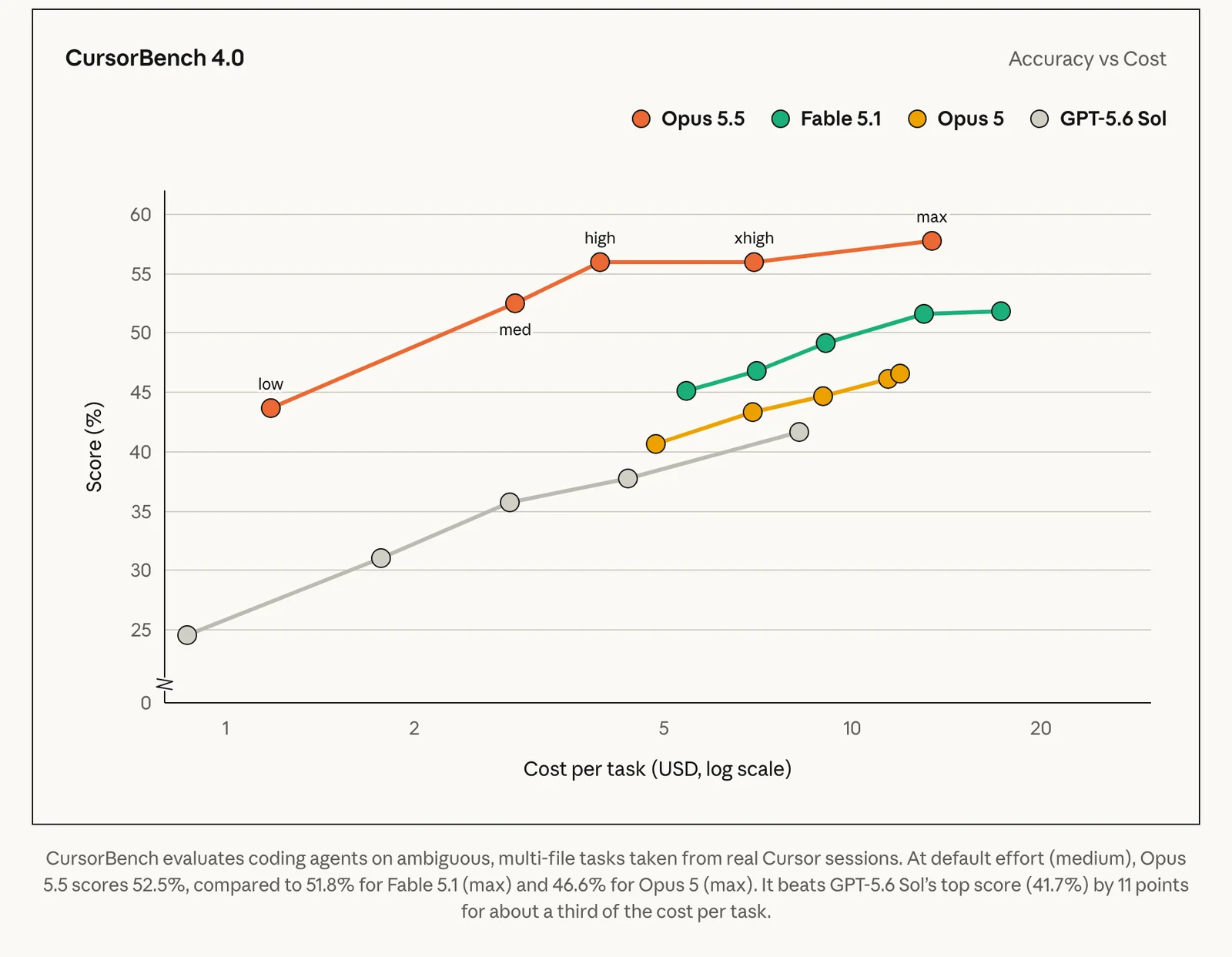
The knowledge-work charts tell the same story. On GDPval-AA, Opus 5.5 at medium effort beats Astra at max effort for about a fifth of the cost. AutomationBench is the exception to Opus 5.5's lead: Astra's max setting scores slightly higher at a higher cost.
Safety and safeguards
Anthropic calls Opus 5.5 its first release since it called for pacing the frontier, and says METR and Frontier Design tested it before release. On an automated behavioural audit of nearly 2,000 scenarios, it reports better results than any recent Claude model on nearly every misalignment measure, and about 85% fewer attempts to circumvent containment boundaries than Opus 5 or Mythos 5.1. Anthropic also discloses that Opus 5.5 "often suspects it is being evaluated", which limits how well pre-release testing predicts deployed behaviour.
Because Anthropic rates the model comparable to Mythos 5.1 in biology and cybersecurity, Opus 5.5 is the first Opus model to launch with Fable 5.1-class safeguards for cyber, biology and distillation. The system card is more precise than the launch page about what happens next: cyber blocks fall back to Opus 4.8, biology and frontier-LLM-development blocks fall back to Opus 5, and distillation and conventional-weapons blocks have no fallback at all. Fallback is automatic in Anthropic's own apps, but API developers must opt in. Routine bug-fixing in source code is permitted; vulnerability discovery in compiled binaries is blocked. Vetted organisations can apply to a new Life Sciences Verification Program, and an expanded three-tier Cyber Verification Program is due in the coming weeks.
Architecture and access
Anthropic does not disclose a parameter count or architecture. It says Opus 5.5 needs less compute to serve than Opus 5, which it gives as the basis for the lower price. Adaptive thinking is always on, the effort parameter controls depth, and the model supports mid-conversation system messages, per-message effort in beta, task budgets, prompt caching with a 512-token minimum, batch processing, the Files API, PDF input and vision.
Unlike Fable 5.1's default terms, Opus 5.5 is available with zero data retention, and the EU AI Act watermarking measures introduced with Fable 5.1 apply. Preserved thinking, the anti-distillation control, also carries over: for API accounts created on or after 31 August 2026 at 00:00 UTC, replaying an Opus 5.5 thinking block after the system prompt, tools or an earlier message has changed returns an error. Older accounts can opt in.
Migration impact
Anthropic documents four breaking changes for code already running on Opus 5:
thinking: {"type": "disabled"}and manualbudget_tokensrequests return a 400 error, so lower effort instead;- forced tool use with
tool_choiceset toanyor a named tool returns a 400 error, so useautowith strict tool use or structured outputs; - thinking blocks are tied to the model and the conversation: Opus 5.5 reasoning carries forward only to Fable 5.1 or Mythos 5.1 on the Claude API, and unreadable blocks are silently dropped after a model switch; and
- on the Claude API and Google Cloud, the older
computer_20251124tool is rejected in favour ofcomputer_toolset_20260801, although Bedrock still accepts it.
Two quieter changes need the same attention. Requests without an explicit effort now run at medium rather than Opus 5's high, which invalidates any cost or quality baseline taken on defaults. Short notes between tool calls now arrive in thinking blocks that are empty at the default display setting, so interfaces that stream progress updates go quiet without an error. Declined requests return HTTP 200 with stop_reason: "refusal", and server-side fallback is available in beta.
What an evaluation should test next
For Opus 5.5, a credible internal gate should include:
- matched Opus 5, Fable 5.1 and Opus 5.5 runs with effort set explicitly rather than inherited from defaults;
- total task cost, including cache writes, reads and misses, compared with Anthropic's 40% estimate;
- the share of tasks completed by Opus 4.8 or Opus 5 after a safeguard intervention, logged per request;
- refusal and re-routing rates on legitimate security, biology and data-analysis work;
- migration tests for disabled thinking, forced tools, history edits, computer-use tool versions and progress-update rendering; and
- repeated long-session runs covering latency, variance, recovery from failed steps and rollback.
Our Opus 5 release brief first flagged fallback visibility as a migration gate; Opus 5.5 makes it more pressing because safeguards now route work to two different models. The Fable 5.1 brief covers the preserved-thinking rules this release inherits, the GPT-6 Astra analysis is the main competitive baseline, and the model change-control guide explains how to keep these comparisons reconstructable.
AIEngine verdict
Opus 5.5 is a substantial release. Near-Fable capability claims at Opus-tier prices, much cheaper cache reads and zero-retention availability make it the new default candidate for most Claude workloads. Its strongest evidence is efficiency rather than benchmark leadership, which is narrow in places and absent on two published rows.
The practical risk sits in the integration. A default-effort change, four breaking request patterns and safeguard routing to older models mean the same model ID can deliver different cost, quality and provenance than a launch chart implies. Evaluate the model your requests actually reach, with effort pinned and fallbacks logged, before moving production traffic.
Primary sources
- Anthropic launch announcement
- Claude Opus 5.5 system card
- What's new in Claude Opus 5.5
- Claude models overview
- Preserved thinking documentation
Image provenance
Hero image: Anthropic's official Claude Opus 5.5 release artwork. The locally served WebP is a normalized crop of the first-party launch asset.
The benchmark table and six cost charts are Anthropic's own launch graphics. The launch page renders them in the browser rather than as image files, so they were captured from the live page on 22 September 2026 at 1440px width and 2x scale, one chart tab at a time, then converted to WebP without redrawing or editing the data.